
THE WISHING WANDERER: A CASE STUDY
The case that inspired me to create The SOJOURN™ Readiness Diagnostic
She sat across from me and named everything she wanted. A new career. A family. A home she had built on her own terms. A life in this country that belonged entirely to her.
As I wrote it all down, I understood that her desire was the most alive thing in the room.
I will call her “E.”
E was in her early thirties, European-born, and had been living in the United States for five years. She was working toward citizenship, navigating the green card process, and building a life far from the family and traditions she had grown up with. E was well-educated and articulate, and our early sessions flowed with a fluency that felt organized and purposeful.
E came to coaching while in psychiatric treatment.
My first condition was immediate and firm: she would remain in treatment with her current provider, and she would authorize a connection between us so we could coordinate our work to ensure her safety. She agreed. She followed through on both.
As our sessions continued, the picture that emerged was more layered than the first conversations had revealed.
The direction E named in one session had been replaced, entirely and sincerely, by a new one the following week. A business venture arrived where a job search had been. Marriage replaced singlehood. The desire for a child became no desire at all. A life built alone became a life built with a partner. She took her calls from places full of noise and competing demands, and she arrived at each appointment carrying none of the previous week’s work.
This engagement took place several years ago, but still informs my practice today.
The Prompt
I thought of E when I began building the client selection process I use today. The question I kept returning to was clear. Had I known, before our first session, where E actually stood in her readiness to translate insight into action, would I have structured her support differently?
The answer to this question was immediate and affirmative. It changed the architecture of how I begin every engagement, and it produced the tool this piece is named for.
What I needed then, and did not have in place, was a structured readiness assessment. What I had instead was a deepening professional frustration and a pattern I eventually learned to name.
E introduced me to what I now call the "guess what?" deflection. The "guess what?" deflection arrived at a specific moment: precisely when a direct accountability question was posed. A genuine (and sometimes made-up) win or positive development appeared at that exact moment and reorganized the session around it. The accountability question waited, unanswered, while the celebration concluded. I named the pattern to myself before I named it in the room. I will admit that it took me longer than it should have.
That was also the moment when my "That wasn't the question" response was born.
My frustration across those sessions was a professional signal. It pointed to a gap in my intake process, and E gave me the clarity to see it.
My Client Archetype: The Wishing Wanderer
The Wishing Wanderer arrives with a desire that is vivid, genuine, and abundant. She wants a different life, a clearer direction, a more self-authored future, and that wanting is among the most real things about her. What she brings to the engagement is a desire that has not yet organized itself into a direction she can sustain over time, amid friction, and with accountability.
She circles the threshold. She can describe what she believes waits on the other side with remarkable specificity and feeling. The crossing requires an interior foundation, which she is still building.
The Wishing Wanderer is my least experienced coaching encounter and my most instructive one. She is the client who taught me that readiness cannot be assumed from desire alone.
The Six Characteristics in Action
Let me trace the six characteristics of the Wishing Wanderer as they revealed themselves in E’s sessions.
The Abundant Dreamer
E generated new possible futures in every session. A business. A career shift. A family. A partnership. A solitary life built entirely on her own terms. Each possibility arrived with genuine investment. Each had been replaced, by the following week, with an equally genuine and equally new possibility. The dreaming was constant and sincere. The interior architecture to hold a single dream long enough to build toward it was still forming.
The Shifting Compass
E’s sense of direction changed in response to whatever had moved through her life between appointments. Each new direction was sincerely meant at the moment of naming. The stable, self-authored direction that could withstand the pressures of her relational world, her financial situation, and her unresolved questions about her future had not yet been found. Each week, we began again from a different starting point.
The Graceful Deflector
The “guess what?” statement was E’s most consistent pattern and her most instructive one. She brought genuine wins, real moments of forward motion in her life, to redirect the session away from the accountability question approaching. The timing was precise, and the execution was natural. My read was that she had learned this pattern over the years rather than constructed it for the session. She had a reliable way to steer a difficult conversation in a different direction, thus protecting herself from the discomfort of answering the question at hand. I named it. She was surprised. We kept working.
The Relational Mirror
E’s goals aligned with her family’s expectations as fully as they did with her own desires. Her financial dependence on her parents was directly connected to her difficulty naming and pursuing a direction on her own terms. She wanted to author her life independently, but she found that the terms available to her belonged to others. The relational field around her shaped every goal she brought to the session, and separating her own desires from the inherited ones required a stability she had not yet built.
The Stirring Interior
E knew her life required change. She felt the internal movement with urgency and clarity. What she could not yet do was name the specific change with enough precision to make a decision and sustain it across consecutive weeks. The stirring was real and active. The language to organize it into a direction with staying power was still forming. She arrived each week with a new translation of the same unnamed internal signal.
The Capable Presenter
E showed up. She complied with the conditions of the engagement, articulated her desires fluently, and engaged with the session content during our conversations. She produced every visible marker of a client prepared to work. The gap between what she presented in the session and what she could sustain over the week was the core challenge of the engagement, and I did not see it clearly at the start.
E and the SOJOURN™ Coaching Model
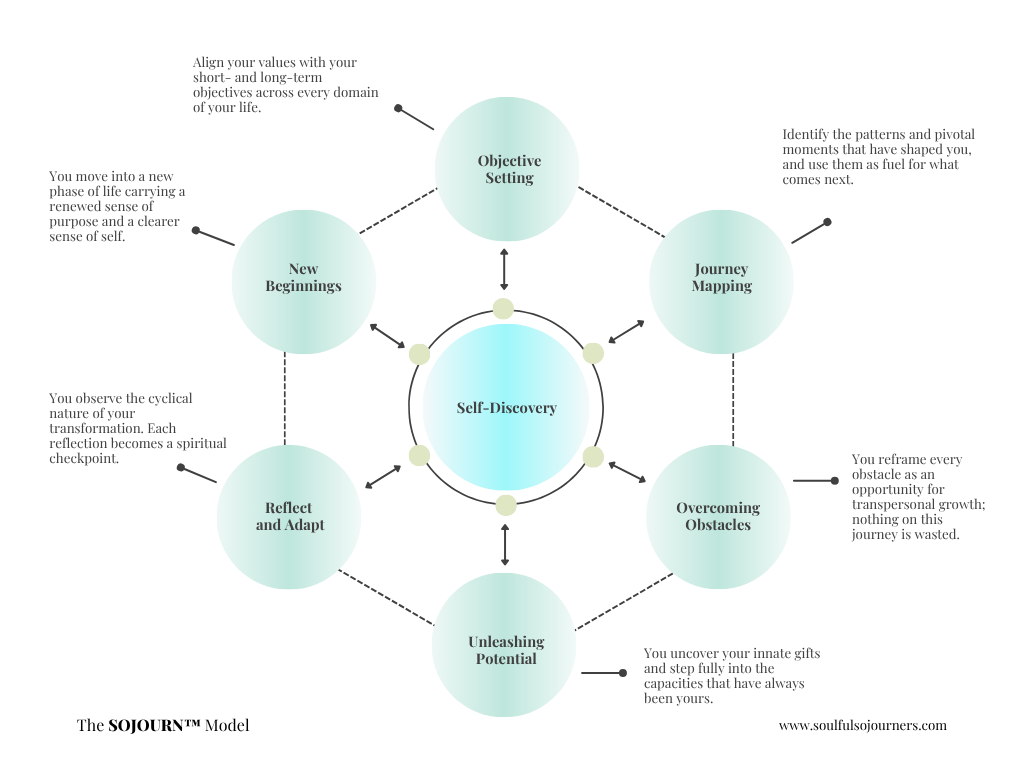
E’s movement through the SOJOURN™ Coaching Model revealed, in practice, the diagnostic gap the engagement produced.
Objectives reset each week before the previous week’s direction had taken root.
Journey Mapping, the process of reading a person’s own history as strategic information, required a stable enough position to examine the past without the next arriving concern overtaking the examination. E’s map shifted with every session.
Obstacles arrived as session resets rather than as information. The “guess what?” pattern appeared precisely where obstacle work would have begun, redirecting the conversation before the obstacle could be named and examined.
Unleashing Potential requires a stable launch point. E’s capacity was visible and real, and the conditions to activate it consistently across the engagement had not yet been established.
Reflect and Adapt arrived each week without the accumulation it requires.
New Beginnings, the threshold the SOJOURN™ model asks a client to cross with a clearer and more honest sense of self, remained on the other side of a door E approached and had not yet opened.
Self-Discovery, the destination the SOJOURN™ Coaching Model moves toward, requires the client to occupy a stable enough position to encounter herself honestly.
E was at Stage 1 of the SOJOURN™ Readiness Diagnostic: Stirring. She was experiencing internal movement, dissatisfaction, and longing, without yet having the language or the stable ground to organize that movement into a defined decision.
On the surface, she presented with the energy of a Stage 3 client. A structured readiness assessment at intake would have placed her accurately from the beginning.
When the time came to consider renewal, E and I reached the same conclusion together: when asked to name a goal to carry forward, she arrived without one. The engagement ended with honesty, care, and continued support and connection outside the coaching container. I wish her success, and know she is successful in her own way.
Why I Built the SOJOURN™ Readiness Diagnostic
The SOJOURN™ Readiness Diagnostic exists to answer one question at intake: where is this person in the process of translating insight into aligned action?
Had the diagnostic been part of my intake process when E arrived, her results would have placed her at Stage 1: Stirring.
The Stirring stage calls for careful attention to awareness, language, and internal pattern recognition. It calls for support designed for someone whose interior movement has not yet been organized into a named direction.
The diagnostic would have redirected E toward the appropriate form of support and protected us both from the professional and personal cost of a misaligned engagement.
Today, every prospective client completes the SOJOURN™ Readiness Diagnostic before we discuss working together. My workflow for admitting clients has matured in the same way I have. Each coaching prospect must submit an application that includes questions and a clear definition of the cost of my services. By the time these two pieces are in place, I have a good sense of the potential client's needs and can proceed to send the rest of the packet their way.
This sequence protects the client from investing in a process she is not yet positioned to use. It protects the practice from having to absorb the cost of a misread. And it ensures that when we sit down together for the first time, we begin with an accurate and shared understanding of where she is and what she needs.
Conclusion
A coach and her processes mature with time and practice. Claiming perfection and fool-proof systems from the beginning is (What's the word?) foolish.
Maybe you recognize the Wishing Wanderer in yourself: the vivid desire, the shifting directions, the sense of urgent wanting that has not yet found its container. If so, the SOJOURN™ Readiness Diagnostic was built for exactly this moment.
Stirring is a stage. It carries specific requirements and specific forms of support. The diagnostic places you accurately and points you toward the next appropriate step.
E taught me that readiness assessment is the foundation on which every other part of the engagement rests. I built a tool from what that case produced, and every client I serve today benefits from what E gave me. I am grateful for it.
Note: While staying true to the essence of my client’s story and their presenting circumstances, identifying details have been changed, and a pseudonym initial has been used to protect their identity and confidentiality.