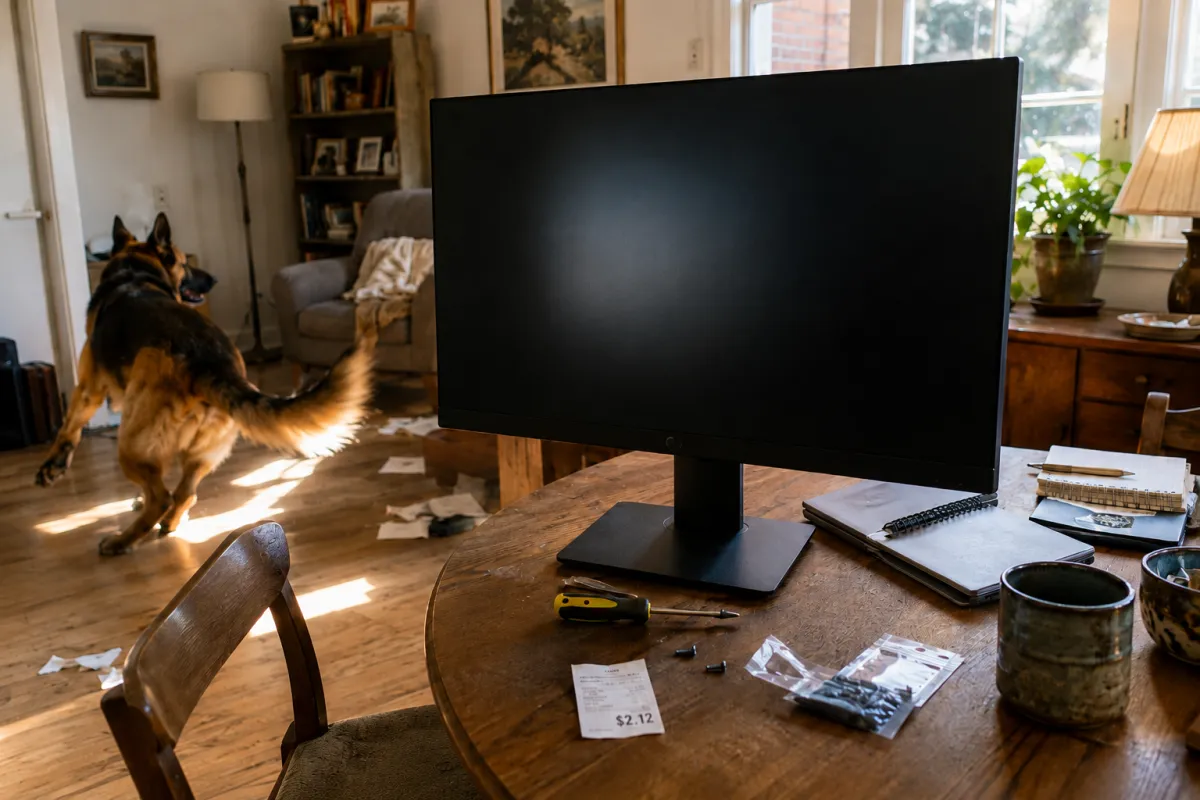
$2.12: Four Screws and a False Permanence
My main monitor had been wiggling for more than a year.
A few years ago, I installed monitor arms and removed the original stand. When I moved and wanted my old setup back, the screws that held the stand in place were nowhere to be found.
Always the DIYer, I pulled a few screws from my bottomless reservoir of useless things and fixed it, or so I told myself.
The screws were wrong. The monitor swayed. The movement bothered me every day, and every day I found something more important to do.
Last week, Noah, my daughter’s dog, who becomes exclusively hers whenever he misbehaves, chased the reflection of light across the ceiling and knocked the monitor down. The fall destabilized it further.
My first thought was to get rid of it as is and be done with that perennial headache.
Instead, the monitor sat on my dining table for several days, disrupting the order my mind demands. As it sat there, one question sat with me:
What else in my life remains broken, patched, diminished, or poorly arranged because I decided I had no choice except to live with it?
My list was longer than I wanted it to be.
Perhaps you have a monitor of your own. Something that wobbles, drags, interrupts, or requires constant accommodation. You notice it. You dislike it. You keep living around it.
Sometimes the thing sits in plain sight. A broken drawer. An unfinished room. A system that no longer works. A conversation you keep postponing.
Sometimes it lives within you.
A belief that you are less capable than you once were. An assumption that you have waited too long. A conviction that you must stay where you are because leaving would cost too much. An idea that other people have choices, opportunities, and room to move, while you must make peace with what you have been given.
After enough time, discomfort stops presenting itself as a temporary condition. It begins to feel like the structure of your life.
Sometimes life sends a dog through the room. Sometimes it sends a diagnosis, a loss, an ending, an unexpected expense, an opportunity, a betrayal, a new responsibility, or a truth you can no longer avoid.
Sometimes nothing dramatic happens. You simply reach the point where your mind, body, or spirit refuses to continue carrying an arrangement that no longer fits.
The disruption does not always create the problem. Often, it reveals the accommodation.
It shows you how much effort you have spent holding something unstable in place and exposes the conclusion that made the arrangement seem necessary. You may have decided that you cannot begin again, that your needs ask too much, or that discomfort is the price of belonging, security, loyalty, or survival.
The monitor on my dining table presented another possibility: the condition was real, but my conclusion about it might have been wrong.
The repair began with a simple question: What would it take?
I found the model number, identified the correct screws, drove to a nearby store, and came home with what I needed. Within minutes, the monitor stood steady.
The total cost was $2.12.
The repair was simple. My thinking had made it difficult.
Comfortable discomfort works that way. Familiarity makes the condition appear settled. Repetition gives it authority. Accommodation convinces us that we have made peace with something when we may have simply stopped questioning it.
The same pattern operates within us. A thought repeats until it sounds like truth. A lack of options at one point in life becomes the belief that no options exist now.
What would it take?
The answer may involve a screw from a hardware store. It may require telling the truth, asking for help, setting a boundary, or reconsidering a conclusion that has governed your choices for years.
Some repairs require minutes. Others require courage, resources, support, and sustained effort.
The question does not promise an easy answer. It restores movement where a conclusion had made the situation appear permanent.
When I looked around my home, I saw physical things that needed only a little attention to function as they should.
When I looked within, I saw beliefs and arrangements that needed examination. I saw places where I had mistaken endurance for strength, familiarity for permanence, and adaptation for choice.
The deeper repair begins when you separate the condition from the conclusion you have drawn about it. The condition may be difficult. The conclusion may still be wrong.
This week, choose one thing you have been living around instead of living with.
It may sit in your home, appear on your calendar, exist inside a relationship, or live entirely within your inner landscape.
Say the question aloud: What would it take?
Then take the first concrete step. Find the information, make the call, ask the question, or set the boundary. Mine required a model number, a short drive, a search through a hardware store bay, and $2.12. My monitor now stands as it should: steady, secure, and fully functional.
The greater repair took place within me. I withdrew my agreement from the idea that discomfort becomes permanent simply because I have tolerated it for a long time.
Sometimes change costs $2.12. Sometimes it requires you to reconsider the conclusion that kept the condition in place.
The first movement begins in the same place: What would it take?